
The “Sand Dunes”
Philately’s Notorious Mirage

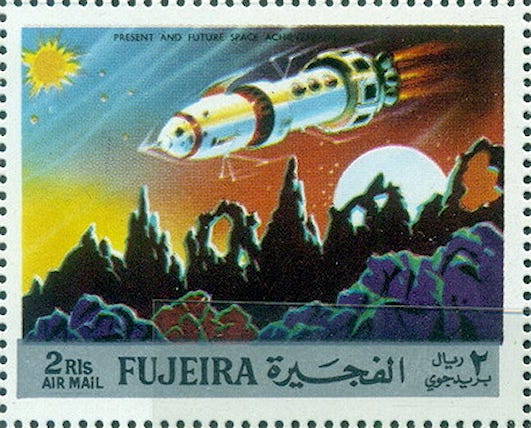
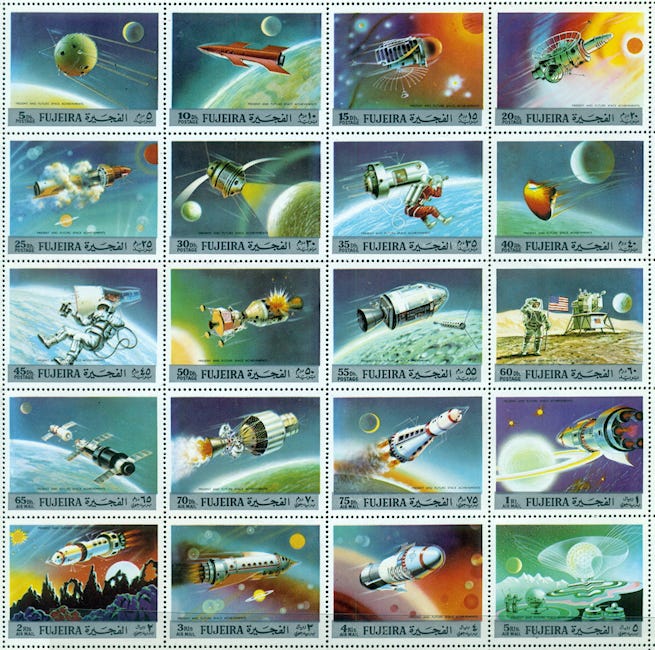
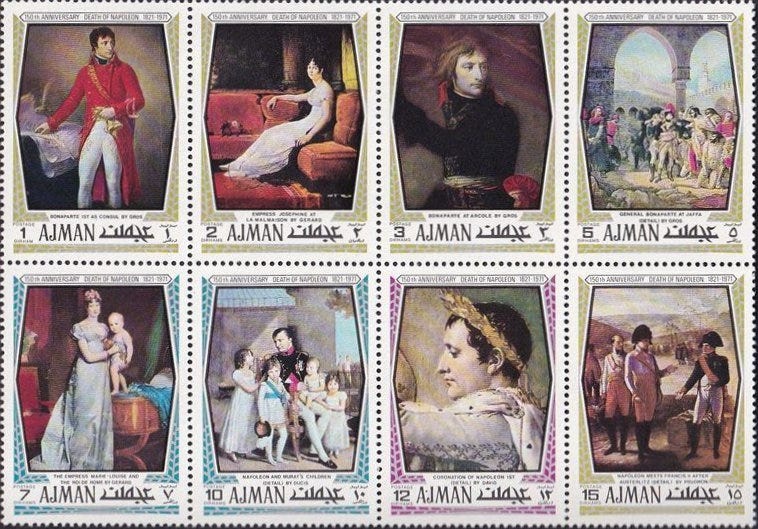
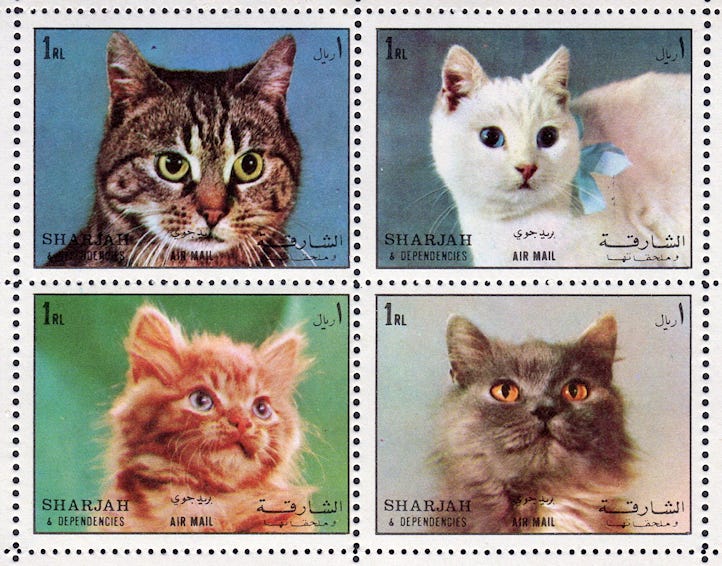
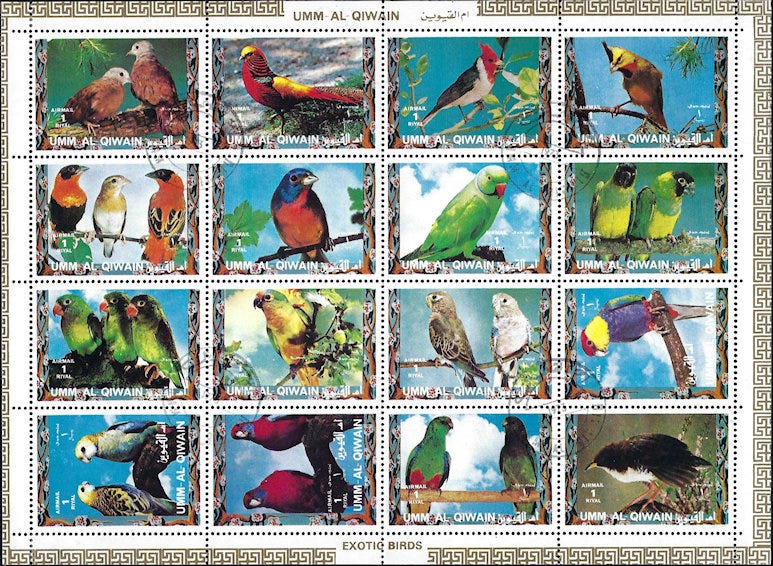
If you collected stamps in the late 1960s or 1970s, you probably remember them, those oversized, colorful issues from places few collectors could find on a map—Ajman, Umm al-Quwain, Fujeira, Ras al-Khaimah. They featured astronauts, Olympic athletes, butterflies, famous paintings, race cars, and other popular topical themes—sometimes all at once. Because they were all issued in the names of small Arab sheikhdoms, they became known, not affectionately, as the “Sand Dunes” issues.
For many traditional collectors, they were a symbol of everything that had gone wrong in modern philately. For others—especially topical collectors—they were irresistible curiosities. Today, with some distance and perspective, it’s worth taking a fresh look at what they were, why they were created, and how they fit into the broader story of stamp collecting.
A (Very) Brief Postal History of the Trucial States
The Trucial States were Gulf sheikdoms that signed protective treaties with Great Britain in 1820, 1892, and 1952. They remained, collectively, a British Protectorate until the treaties were all revoked, on Dec 1, 1971.
During the time the Trucial States were a British protectorate, Great Britain also assumed the responsibility for all of their mail service. None of the States were members of the UPU.
On Jan 7, 1961, a set of 11 stamps inscribed “Trucial States” was issued. These stamps were only used in Dubai.
In June of 1963, Great Britain ceded their responsibility for these postal services back to the individual states and those states began issuing their own stamps. However, none of the states was equipped to produce postage stamps, and, since nature abhors a vacuum, the void was soon filled by so-called “philatelic agencies.” These agencies, in particular an American philatelist and businessman, Finbar B. Kenny, contracted with several sheikhdoms to produce stamps on their behalf. In return for a share of the revenue, the rulers granted permission to print stamps bearing their country’s name. The result was a flood . . . no, a deluge.
Before going on, though, let’s establish who the players are.
Abu Dhabi, the Little Dune That Wasn’t
Of the 7 Trucial States that began issuing their own stamps in the 1960s, only Abu Dhabi maintained a British administration (through Bahrain) of their postal services, with a British postal agency opening on 30 Mar, 1963, with the Abu Dhabi government assuming full control 1 Jan 1967. Abu Dhabi also produced their own stamps without the involvement of a so-called “philatelic agency.” They were designed and printed in London by established firms such as Harrison & Sons and De La Rue, and commissioned through official government channels. They were also the only individual Trucial State to hold UPU membership, from 30 Mar 1963 to 30 Mar 1973. For these reasons, the stamps of Abu Dhabi maintain an air of legitimacy, are recognized by the catalogue publishers, and have been voted off the “Sand Dunes” island.
The Once and Future Dunes
When talking about the Sand Dunes, then, we are looking at 6 of the former Trucial States and one heretofore unmentioned stamp-issuing entity, Manama. Below is a table showing the stamp-issuing years the Scott Catalogue recognizes for each, along with the number of stamp issues Scott recognizes and the total number of stamps listed at StampWorld.com up through 1972.
Ajman: 1964 – Dec 1965 (Scott: 53, StampWorld: 3,149)
Dubai: Jun 1963 – Jul 31, 1972 (Scott: 225, StampWorld: 433)
Fujeira: 1964 – Aug 1965 (Scott: 46, StampWorld: 1,539)
Ras Al Khaima: Dec 21, 1964 (Scott: 8, StampWorld: 951)
Sharjah: Jul 1963 – Apr 1965 (Scott: 129, StampWorld: 1,496)
Umm Al Quwain: Jun 1964 - Oct 1970 (Scott: 63, StampWorld: 1,765)
Manama: Between 1966 and 1972, the city of Manama, in Ajman, also also had stamps issued in its name. The stamps include the inscription, “Dependency of Ajman,” which was just a marketing ploy by the philatelic agency to make them appear legitimate. The Scott Catalogue does not confer any legitimacy on these stamps and does not list them. While Stanley Gibbons does list these stamps, the catalogue includes a footnote saying they were either issued in excess of postal needs or not made available to the public in reasonable quantities at face value. StampWorld.com lists 1,477 stamps for Manama.
These sheikhdoms had tiny populations and minimal postal needs. Yet they suddenly began issuing enormous quantities of stamps—far more than local mail could possibly require. In fact, while the Scott Catalogue recognizes just 63 stamps for Umm Al Quwain, there are many hundreds more Scott ignores as being “wallpaper,” the philatelic term for stamps that were cranked out by the boatloads, with no valid postal purpose. The website StampWorld.com, on the other hand, does list every stamp they know of, and they show 1,765 stamps issued by Umm Al Quwain between 1964 and 1972, with 1,278 issued in 1972 alone. Likewise, for Ajman, Scott recognizes a mere 62 stamps, issued in 1964 and 1965, across all classes of service—regular, airmail, officials, and airmail officials—while StampWorld lists 3,149, from 1964 to 1973.
Why so many stamps? Simple. The global stamp market was booming. The postwar decades saw explosive growth in topical collecting. Kids were collecting space stamps during the Gemini, and Apollo eras. Sports fans wanted Olympic issues. Art lovers sought reproductions of Old Masters. Stamp agencies realized there was money to be made producing colorful, thematic stamps aimed directly at collectors rather than postal customers.
To be sure, many were beautifully printed, some by respectable security printers. Others were less refined. All were produced with one audience in mind—collectors abroad. In only rare cases did any stamps see genuine postal use. Many were canceled-to-order (CTO) in bulk and shipped directly to the packet trade.
Why Collectors Turned Against Them
Traditional philately has long valued certain principles:
Legitimate postal necessity
Reasonable issue quantities
Connection between stamp subject and issuing country
Genuine postal usage
The Sand Dunes issues violated nearly all of these. Tiny desert sheikhdoms issuing stamps about European paintings, American astronauts, and Japanese butterflies raised eyebrows. The sheer volume felt excessive; established collectors saw it as exploitation of beginners and topical enthusiasts.
Major catalogue publishers responded in different ways. Some listed the issues reluctantly. Others placed them in back-of-the-book sections. A few blacklisted certain emissions altogether, especially late issues that appeared to have been produced without clear local authorization.
By the mid-1970s, “Sand Dunes” had become shorthand for speculative, excessive, and exploitative philatelic production. For their part, the sheikhdoms were not concerned with philatelic appearances. Remember, this was a time when Bahrain was the only Gulf State to have struck oil. So, for the Trucial States, these stamps were a welcome source of revenue; they received money for nothing (and sheikhs for free).
Were They “Illegal”?
Well, no, not really. These issues were officially authorized by the rulers of the sheikhdoms. They were legal postage stamps in principle, even if they were rarely used postally.
However, toward the end of the boom, especially around 1972–73, confusion arose. The formation of the United Arab Emirates centralized postal authority, but some agencies continued producing stamps in the names of former Trucial States without clear authorization. This muddied the waters. Catalogue editors faced the uncomfortable task of deciding which issues were legitimate and which were not. That uncertainty contributed to their blacklisting and to the stigma attached to them.
The Aesthetic Question
As mentioned earlier, many Sand Dunes stamps are visually striking. They utilized large formats, bold colors, metallic inks, and topical themes that appealed to young collectors. Space exploration issues during the Apollo years were especially popular. Olympic sets, wildlife series, and art reproductions were equally eye-catching and popular. From a design standpoint, they anticipated modern collector-oriented stamp marketing. In a way, they were ahead of their time. Today, it’s common for postal administrations worldwide to issue stamps primarily aimed at collectors, complete with souvenir sheets, prestige booklets, and limited editions. The Sand Dunes simply did it earlier, and more aggressively.
Market Performance
As for catalogue values, most Sand Dunes issues never appreciated significantly. Massive print quantities and widespread speculative buying kept prices low. Even today, many sets sell for pennies on the dollar compared to their original issue price. That reality has cemented their reputation among traditional collectors as cautionary tales. Yet, there’s another perspective. For topical collectors assembling albums and exhibits on space, sports, fauna, or art, these issues can still provide affordable, colorful material. Genuine commercial covers bearing these stamps, properly used in period, are scarce and increasingly draw interest from postal historians. The irony is inescapable; the most despised material of one generation can become the specialized study of the next. I have seen, myself, more than a few stamp forum posts from collectors expressing interest in these stamps.
Reconsidering the Sand Dunes
So how should we view them today? Certainly not as exemplars of postal necessity, nor as paragons of restraint. Are they mere junk?
They are artifacts of:
The 1960s topical boom
The commercialization of global philately
The pre-UAE political landscape
The tension between postal function and collector demand
In that sense, they tell a fascinating story about the hobby itself. Stamp collecting has always balanced two forces in the hobby: scholarship and commerce. The Sand Dunes simply skewed that balance to the latter extreme.
The Sand Dunes may have once been a mirage of speculative excess, but viewed through the lens of history, many newer collectors now find them shimmering with meaning. And who’s to say that they are wrong? As has been said many times, there are no rules to collecting stamps, and philately thrives when we approach it with curiosity rather than contempt.
What a great piece - thank you - the Sand Dunes were a staple of the day back when I started collecting in the 1970s. Avoid them, but they were definitely eye catching. Funny how the former protecting power, Great Britain, now pumps out gobs of issues that are eye catching and with no postal need. Same for most legit postal administrations. What goes around comes around, as you astutely observed, and that's fine. There's no real right or wrong way to collect. Whatever makes you happy.
Here is coda to the Trucial States story.
All the Trucial States ceased stamp production from late 1972 through 1973. After the Yom Kippur War in October 1973, the price of oil went from $3.00 a barrel to $10.00 a barrel. There was no longer any financial incentive to produce stamps.
A few years later, a philatelic entrepreneur named Marc Rousso came across the leftovers from this period at a Swiss security printer. Apparently, he made a deal to acquire all of these at a price, I assume, related to the price of waste paper.
He used the Minkus Trucial States Stamp Catalog to evaluate all these stamps. His biography claims "he bartered $45 million (catalog value) ". I assume these were the leftover Trucial States from the printers.
The story is that he used the $45 million as collateral for a loan. The loan was supposedly never repaid.
Big chunks of these stamps are still around.
I was offered a bundle about 7 or 8 years ago