
Philatelic Big Year
Final Report from Dan Golden


This article first appeared in “Stamping Around,” the newsletter of the Mid-Cities Stamp Club, in Texas, and is reprinted here courtesy of the author and newsletter editor.
At the beginning of last year I wrote an article entitled “A New Challenge and a Big Year”, in which I described my intention to combine two hobbies into one, philately and birding. The goal was to see every bird depicted on a US postage stamp and then collect a stamp corresponding to each of those bird species seen. I intended to write quarterly updates on the progress of that challenge, but then I changed jobs, became short on time, and life generally got in the way. As such, I only have this one update to share, and it may be considered a final report on the success of my mission.
Put simply, I bit off more than I could chew and I utterly failed at my challenge. As it turns out, birding is a lot harder than I anticipated. I only saw 27 out of the 142 birds on my list, about a 19% success rate. And it was not from a lack of effort. My father-in-law and I went out to nature preserves, on birding hikes, and even traveled to other states in pursuit of this endeavor. And yet I was unable to achieve what I had set out to do.
The biggest issue was an inability to identify which bird species I was looking at. You see, even when I would catch sight of a bird from a distance and be certain that it was probably a bird on my list, I would be without any sources to immediately help identify it. Seeing a bird is the easy part, determining what I was looking at was much harder. This situation of seeing a bird while being unable to identify it occurred countless times, enough so that I almost dropped the project entirely around mid-summer. In October I still only had seen about 25 birds and I felt like a failure.
So I did what many students in high schools across the country do when faced with likely failure: I cheated. Or more specifically, I amended the rules and allowed myself to use other sources to view birds, namely natural history museums where stuffed specimens would be on display. The Perot Museum in Dallas and the Field Museum in Chicago proved invaluable in expanding the number of birds seen, and when counting these species seen in-person but not alive, the number of birds seen increased to 78, raising my success rate to about a 55%. To use the school analogy again, this meant that I had gone from an F at 19% to… still an F at 55%. Hopefully my imaginary professor is willing to grade on a curve!
An added difficulty was the need to acquire the corresponding stamps out in the “wild,” i.e.: stamp shows, club or APS sales book and regular old trading with collectors. Even when making it “easy” on myself and only counting the bird species I had seen, I only managed to acquire 24/78, a 31% (rounded up) success rate. Again, this can be described as a failure. The biggest issues with this step in the process was that every dealer booth I sat down at in any given show always seemed to have all of the stamps around the one I was looking for, but not the one I needed. Furthermore, the APS and club booklets rarely had anything I needed or had seen yet, making those avenues fruitless as well.
As such, my year-long project can be considered a flop. However, there is a bit of silver lining. This challenge, while a failure, gave me a sense of purpose that, when two hobbies were aligned into one activity, facilitated a greater enjoyment of them both. In fact, it gave me an idea for the future.
Sure, I failed at this year-long challenge. But who says that the challenge should have only been limited to a single calendar year? Dan Golden? That guy’s a clown and you can’t trust anything he says! Dan Golden says that I can remove that restriction and change a year-long challenge into a years-long project, essentially building out a topical collection while going birding at the same time. I’d rather listen to that version of myself any day of the week.
Now that I have justified my failure and encouraged myself to continue the pursuit anyway, I’d like to take the rest of this article to highlight four bird species and/or their stamps that I encountered, or wished to encounter, while on this journey.
The one I fell in love with: the Red-Bellied Woodpecker (USA #3611c)
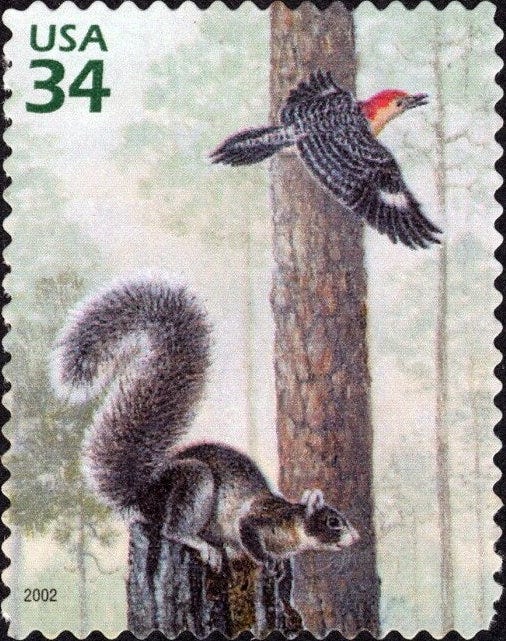
Other than blue jays, robins, and cardinals, I must have seen the red-bellied woodpecker more than any other bird depicted on an American postage stamp during this challenge. It’s unique in the sense that it is not an overly common bird like the cardinal or blue jay, nor is it dull or plain in appearance. The orange above the beak, flash of red on the back of it’s head, and the white and black pattern on the wings makes the red-bellied woodpecker quite pretty to look at. Plus the sound of it pecking against the wood was a pleasing noise to hear, always alerting me to the bird’s presence nearby. My one regret with this bird is that I was never able to acquire its stamp.
The one that got away: the Guam Micronesian Kingfisher (USA #5799m)
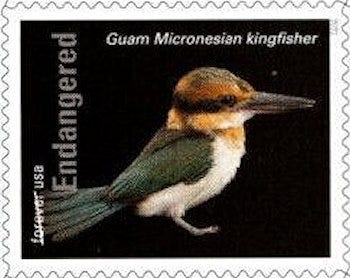
This bird is extinct in the wild, but still exists in a handful of zoos around the country aiming to recover the population. While neither the Fort Worth Zoo nor the Dallas Zoo have any of these birds in their collection, the Brookfield Zoo near where I grew up in Chicago does! We tried to see it while visiting my family for Thanksgiving, but by the time we got there the bird exhibit was closed for the night.
However, I did have one other chance, earlier in the year, to see the Guam Kingfisher at the Cincinnati Zoo while I was in town for a wedding. Unfortunately, prior commitments, i.e. going to the wedding and spending time with old friends, prevented me from making a trip to the zoo. This makes me 0 for 2 in prime opportunities to see a bird that is extinct in the wild and difficult even to see in captivity. Therefore, the Guam Micronesian Kingfisher sticks out in my mind as the one that got away.
The one most deserving of a stamp: the Belted Kingfisher (no stamp)
Seen here, is a photo that my father-in-law took.
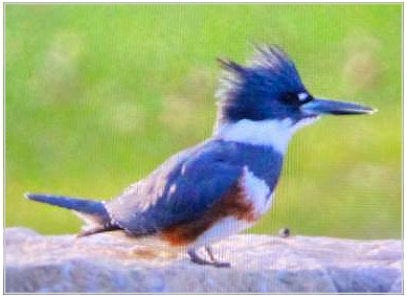
It’s a beautiful bird, characterized by its orange, blue and white feathers, a color scheme matching that of my alma mater, the University of Illinois (I-LL!!), closely enough that there is even a student movement to make the belted kingfisher the new mascot for the university’s sports teams. Considering how popular this bird is and how prevalent it is in the n o r t h e r n US, I’m amazed that there is not a stamp depicting it!
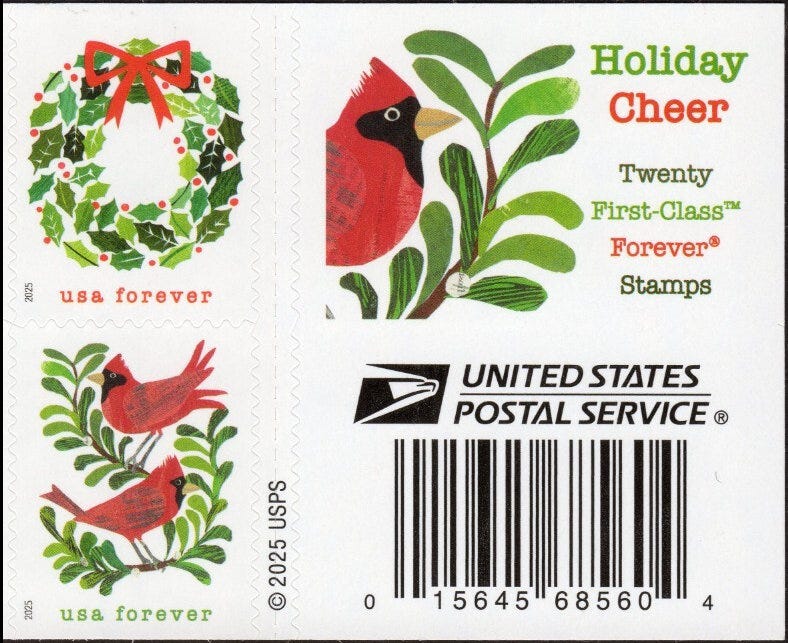
Yet we have 17 different stamps that show a cardinal, including USA #6036 (seen above), released just last fall for the 2025 holiday season. The cardinal is a pretty bird and I like it as much as anyone else, but did we really need to honor it 17 times? Couldn’t it have given up one of its philatelic spots to the belted kingfisher?
The one not meant to be: Emperor Penguin (USA #4989)
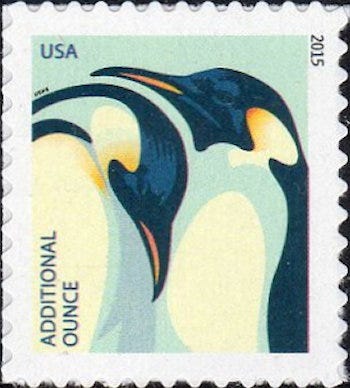
Here is a stamp showing an emperor penguin. I was unable to see this bird in the wild during this year, the most obvious reason for which is because I live in Texas and the emperor penguin, well, does not. I could not justify the expense, nor do I think my wife would have appreciated it had I attempted to convince her of a trip to Antarctica. However, there is actually one zoo in the United States that houses emperor penguins: the San Diego Zoo.
That being said, a trip to San Diego, while significantly less expensive than going to Antarctica, was equally out of the question. Still, though, as can be seen in the photo, below, the Field Museum does, in fact, have a specimen on display that appeared to bow to me as I passed it.
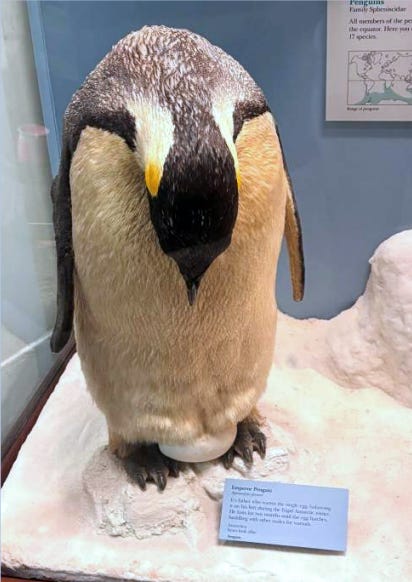
However, this was among the birds whereby I “cheated” in order to see it, since it was seen in a museum, rather than alive in the wild or in captivity.
Alas, perhaps someday I will get to pay my respects to such fowl royalty; but, for now, the emperor penguin and I will have to meet another day. Luckily, the continued pursuit of this project in the future may very well lead me to one day visit this flightless ruler’s imperial court.
 | A guest post by
|