
Bavaria's Schwarzer Einser
It stumbled coming off the blocks, but has become a classic.

In 1849, Bavaria joined the short but growing list of countries issuing postage stamps for the prepayment of mail delivery. While the idea of using postage stamps was made in Bavaria as early as February 1845, objections to their use, such as fear of stamps coming off during transport and the increased labor required to cancel them, delayed the final acceptance of the plan until 1848.
In January of 1849, banknote engraver Paeter Haseney was commissioned by the State Ministry of Commerce to prepare a design along with an estimated cost for the three stamps to be issued, in denominations of 1, 3, and 6 kreuzer. Under the newly reformed postal system, the 1kr value paid for newspapers, circulars, and local letters, i.e. they were delivered within the same city from which they were mailed. 3kr was the standard rate for letter mail to be delivered to addresses up to 20 kilometers distant, and 6kr for delivery addresses beyond 20 km.
Essays of the designs, the so-called “Leaf Essays,” were produced as woodblock prints. Max Joseph Seitz engraved the steel die from which proofs of the 1kr stamp were printed in red and blue. In August of 1849 they were approved by the king, Maximillian II. The final design, though, was printed in black (a decision which would come back to bite them), perhaps due to the lower cost of black ink.
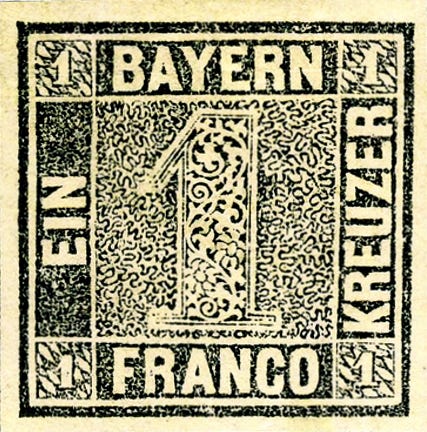
From Seitz’s die, typefounder Gustav Lorenz produced 400 clichés, intended to be enough for 2 full printing plates plus 40 extras for replacement of clichés damaged during printing.
Note: While catalogues mention 1 plate for the first printing, Michel notes that, “According to recent findings, the editions catalogued under Plate I originate from two different printing plates, some of which have different field characteristics.”
These clichés used in the first printing, however, were cast from the standard type-metal alloy first developed by Gutenburg. This was a ternary (three-part) alloy made of lead, tin, and antimony. While fine for relatively smaller jobs with smaller printed areas and low print runs, the plates proved too soft for the rigors of stamp production—the larger printing area (covering 180 stamps cut into 2 counter panes) required greater pressure on the plate, and thousands of sheets were called for—and the details of the printed stamps were soon found to be deteriorating. Production of the stamps was halted after between 2,625 (according to Henke and Sem in their respective books) and 3,082 (according to the Michel Katalog) sheets.
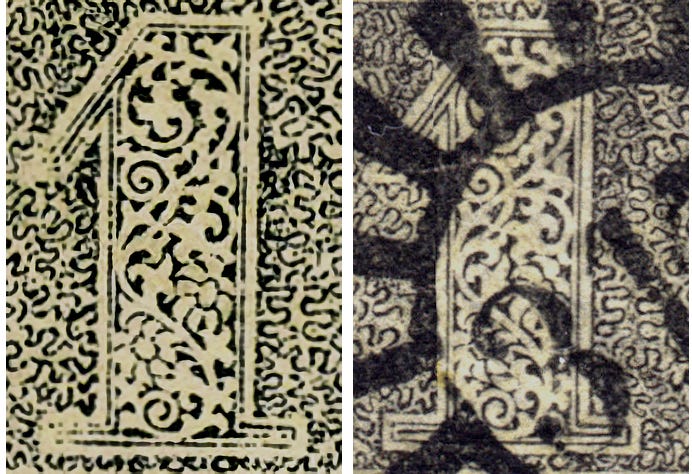
The stamps had not yet gone on sale, and, in fact, production of the 3kr and 6kr values had not commenced. It was decided to create a new printing plate from new clichés, this time made from brass, a much harder and durable metal. These were struck at the Munich Mint (as were those for the 3kr and 6kr stamps). At the same time, it was decided to reduce the printed area by half, with a full sheet now consisting of only 90 stamps. Printing from this new plate began on October 1st, 1849. As with the print run from plate 1, experts disagree on the total number printed from plate 2, with Henke and Sem claiming 4,000 sheets (360,000 stamps) and Michel saying 4,200 sheets (378,000 stamps).
On November 1st, 1kr stamps from the 1st printing (along with the 3kr and 6kr values) went on sale, while stamps from plate 2 appeared in post offices beginning in May of 1850. While the 3 and 6kr values were printed on paper containing silk threads, as a security measure against counterfeiting, the 1kr stamp, being of such low value and, perhaps, as a further cost-saving measure, was printed on paper without silk threads. 1kr stamps from both plates can be found in a grayish black shade as well as a deep black shade, with the deep black shade from either plate commanding a significant premium over the gray-black variety.
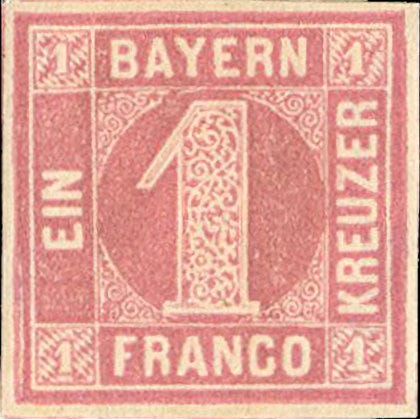
While Bavarian postal officials has consulted with British postal officials when Bavarian stamps were still in the idea stage, they must have slept through the part where they were told (if they were told, of course) that a black design for the stamp would make it difficut to discern a cancellation mark. But that is exactly what the Bavarian post office discovered once the new stamps were placed in circulation. Almost immediately they found the deep black design was very effective in obscuring the cancellation. The ink was then reformulated to a gray-black shade. This proved to be not much better, and the decision was made to halt the printing of black stamps. On July 1, 1850 a new 1kr went on sale printed in a pink shade—Michel says “light purple to vivid red carmine.”
Of the 1kr black, only a few plate flaw varieties are noted—Michel pictures 6. There is, however, one major error variety. During placement of the clichés onto the printing plate, one was inverted, creating a tete-beche pair, where adjacent stamps are inverted in relation to each other. The error was quickly discovered and corrected.
A 2021 article in Linn’s Stamp News by Sergio Sismondo mentions 2 “famous complete sheets” that contain this error pair. Also known are a block of 12 containg one inverted stamp, from the Ferrari collection, sold to Alfred F. Liechtenstein in1923, and Michael Baadke, in a Linn’s article from May 20th, 2019, noted a block of 15 containing an invert from the Erivan Haub collection being slated for auction. Other than those, only 3 singles are known. Though separated from the pair, they were identified through plating—matching up flyspeck plate flaws in the design with those known on the inverted stamps.
Bavaria’s 1849 1-kreuzer black stamp has since cemented its classic status by earning a nickname in the manner of Great Britain’s Penny Black, Guyana’s 1c Magenta, and Sweden’s Treskilling Yellow, being christened Der Schwarzer Einser, or The Black One. In unused condition, the stamp is neither rare nor particularly valuable, compared to other number ones of the era. The 2025 Scott Catalogue values it unused at $1,000, and a quick perusal of a couple popular sites showed listings for right around that price. That might not be a bad way to treat yourself with next year’s income tax refund.
Once again, thanks for reading. Your support is deeply appreciated.